Overview
Installation
Users Guide
Support
Overview
haneWIN TFTP Server for Windows is a fully-realized TFTP server for all Windows Versions. The TFTP Server runs as a background service and doesn't require permanent attendance. It has been designed to work reliable and secure in background operation mode using a high-performance multithreaded architecture.
The software is implemented in 32- and 64-bit versions.
The software provides a TFTP Server (as application and as NT service)
and TFTP client based on RFCs 1350, 2347-2349 and TFTP mulicast based on RFC 2090.
All TFTP options are supported.
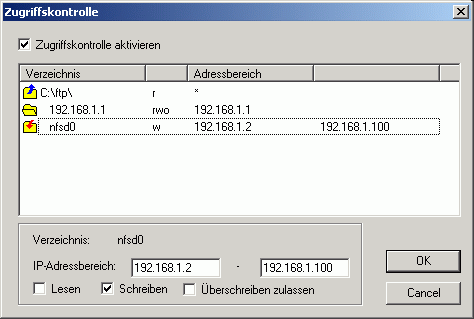
Access control is provided per directory for client IP address and type of
operation.
A native TFTP service is implemented for Windows 200x/XP/Vista/7/8/10.
A Control Panel applet gives interactive access to the service.
Installation
- Requirements
-
Windows 200x/XP/Vista/7/8/10 system configured for TCP/IP
- Installation of the TFTP service on Windows 200x/XP/Vista/7
-
- Install the software by running the setup.
- Use Install TFTP service from the start menu to install the server as service.
- With the control panel applet TFTP Server you can configure and monitor the service.
- Preparation of TFTP Server Application
- Extract the zip-archive, start the application.
Users Guide
The Info Box at startup is displayed only for the unregistered version.
The main windows of the TFTP server displays the status of all active client connections (addresses, progress and type of operation, accessed file).
Running the TFTP server as a Service on Windows 200x/XP/Vista/7
The server can be installed as a service on Windows 200x/XP/Vista/7 for background operation. The service can be configured and monitored by the Control Panel Applet TFTP Server.
- The Service is installed with the command:
TFTP4NT -install
and automatically started on Windows startup. The service can be started and stopped manually through the service control panel. - Use the command
TFTP4NT -remove
to stop and remove the TFTP server service.
- Menus
- File
- Start
- if selected the server accepts new connections.
- Stop
- if selected new connection requests to the server are inhibited. Active connections are not affected.
- View log
- displays a log of all TFTP client requests.
- Exit
- terminates the program
- Options
- Preferences
-
for changing configuration settings.
General
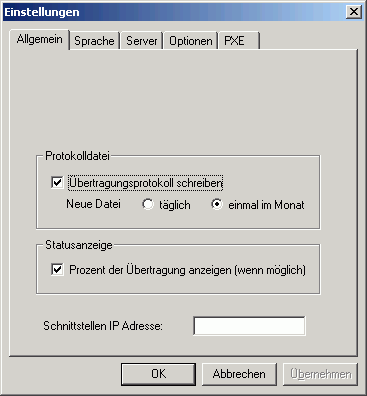
By default the Server is started on all local interfaces. You can restrict the server to one interface only by specifying the local interface IP address.Server
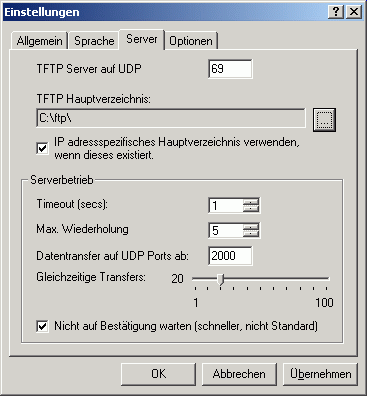
A server root directory must be defined. Any client access outside of the root directory tree is denied. An option enables the server to use a subdirectory of the root directory as a client specific root directory. If this option is enabled and a subdirectory with the IP address of the client exsists, it will be used as the root directory for the client.
The sever allows indicating the range of UDP ports, used for transmitting the data. This allows network administrators to regulate firewall rules, approving the traffic, generated by the server. The UDP port range is defined by specifying the first UDP data port and the number of active clients.Options
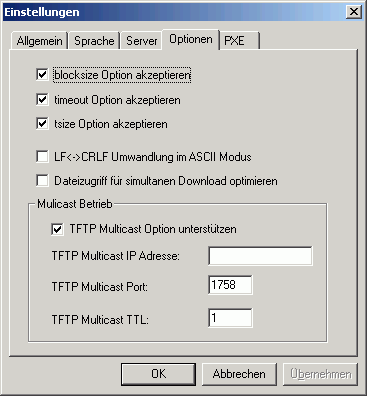
As part of a request TFTP clients can send options to the server. The server can accept or reject the options.- The blocksize option allows the client to choose a data packet size greater than 512 bytes.
- The timeout option allows the client to choose the timeout value for retransmissions. Otherwise the timeout value set on the server will be used.
- With the tsize option the client can inform the server about the total size of the transfered data.
With TFTP Multicast clients can download a file simultanously. The file is sent by the server to the specified multicast address and port. If more than one multicast transfer is started the multicast port number is incremented.PXE
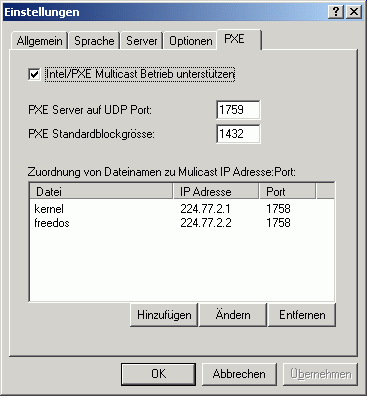
The Intel/PXE specification uses a different protocol for multicast operation. Multicast configuration parameters are sent to clients using DHCP options.- Multicast requests are directed from a client to an extra server port.
- The default blocksize is 1432 bytes.
- Each file downloaded using multicast operation is send to an unique multicast IP address and port.
- Access control
-
Daim Ul Islam English Pdf Site
Al-Qāḍī al-Nuʿmān's Daʿāʾim Exegesis | PDF | Quran | Islam
For centuries, (The Pillars of Islam) has stood as the definitive source of law and tradition for the Ismaili community. Authored by the renowned scholar Al-Qadi al-Nu’man under the guidance of the Fatimid Caliph-Imam al-Mu’izz li-Din Allah, this work remains a cornerstone of spiritual and legal life for millions, particularly within the Dawoodi Bohra community.
This comprehensive guide explores the history, legal structures, and thematic breakdown of the Da'a'im al-Islam , alongside legitimate paths to access its English PDF translations. Historical Origins & Context
: Translations of specific Arabic legal terminology (e.g., batin vs. zahir ). Academic and Theological Use
Absolutely. The book is a historical and legal treasure. Asaf Fyzee intended his translation for an academic audience. There are no restrictions on reading it for knowledge. Daim Ul Islam English Pdf
When searching for a reliable , ensure the file contains:
Rules and mystical purposes behind fasting, particularly during the month of Ramadan.
The most reliable way to access the PDF is through academic library systems. Major libraries, including those at Columbia University and the University of Michigan, have cataloged the volumes. The HathiTrust Digital Library offers a "Limited (search-only)" view of both volumes. This means you can search within the text for specific keywords and view snippets, which is useful for academic research but not for reading the entire book.
Published in 2002, this covers the seven spiritual pillars. Al-Qāḍī al-Nuʿmān's Daʿāʾim Exegesis | PDF | Quran
The book’s influence is so profound that it forms a core part of the curriculum at institutions like Al Jamea tus Saifiyah. Believers study the text in sabaqs (lessons) to understand the halal (permissible) and haram (forbidden), and to learn how to lead a life grounded in the principles of the Shariah.
For followers, it serves as a guide for daily spiritual practices and theological understanding.
Readers can access "Daim Ul Islam English Pdf" through various online sources, including:
Guidelines on charity, almsgiving, and the redistribution of wealth. Historical Origins & Context : Translations of specific
is the foundational manual for the Dawoodi Bohra community and a primary source of Fatimid law. Al-Qadi al-Nu’man
Warning: Be cautious of random PDFs on unknown websites. Many scanned versions contain typos, missing pages, or incorrect footnotes. The most authoritative translation is by the late scholar , revised and annotated by Ismail K. Poonawala .
: Al-Qadi al-Nu'man (d. 974 CE), the founder of Ismaili law and chief justice under the Fatimid Caliph al-Mu'izz.
: Offers a PDF version containing significant selections from Volume I.
Da'a'im al-Islam (translating to "The Pillars of Islam") became the official legal code of the Fatimid state. Rather than relying on speculative reasoning (ra'y) or analogy (qiyas), Al-Nu'man meticulously anchored his legal rulings in traditions (hadith) traced directly back to the Prophet Muhammad and the Shi'ite Imams, particularly Imam Ja'far al-Sadiq. Structural Overview and Core Themes
: Regulations governing charitable taxation and financial purification.
- Help
- Contents
- starts a HTML browser displaying the manual.
- Register
- prompts for the license key and your name, company. Check the Info menu to find out if the license information was accepted.
- Show License
- displays the conditions for using this software.
- About...
- displays program version information.
Using the TFTP Client
TFTP.EXE is a Win32 command line TFTP client.The implementation of the client as a command line program allows easy use of the client for automated tftp data transfer from application or procedures.
Usage: tftp [Options] server GET|PUT file [local]
- server: IP address or name of the TFTP server
- file: Name of file to transfer
- local: Local name of file
- Options:
- -a mode ASCII, default OCTET
- -b<blocksize> block size in bytes, default 512
- -d write debug messages
- -l show transfer activity
- -o override if local file exists
- -p pipe: send data from stdin/receive data to stdout
- -r<retries> number of retries on timeout
- -s disable transfer size option, default enabled
- -t<timeout> retransmission timeout in seconds, default 1s