4Front ProAudio VST/VSTi





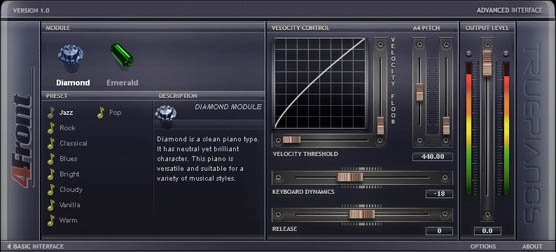
| 4FRONT TruePianos TruePianos is a new virtual piano VSTi based on a combination of physical modeling, synthesis and sampler techniques. Using a combination of the best what these individual technologies have to offer, TruePianos provides great playability by allowing itself to be easily adjusted to the combination of your unique playing style and the specific characteristics of your MIDI keyboard, instead of the other way around. It doesn't attempt to meticulously simulate existing pianos but instead provides realistic and expressive range of piano modules, each with individual dry sounding presets that you 'just play'. |
||
Two Kinds Of Knowledge Ew Kenyon Pdf <100% HOT>In conclusion, E.W. Kenyon's teachings on the two kinds of knowledge offer a powerful and practical framework for understanding the Christian life. By embracing spiritual knowledge and applying its principles, we can experience a deeper level of intimacy with God, walk in victory, and fulfill our purpose in life. We encourage you to explore Kenyon's teachings further and discover the transformative power of spiritual knowledge for yourself. The knowledge of good and evil has its limitations. It can tell us about right and wrong, but it cannot give us the power to do right. It can reveal our sin, but it cannot forgive our sin. It can make us feel guilty, but it cannot give us peace. According to Kenyon, there are two primary kinds of knowledge: natural knowledge and spiritual knowledge. The former is acquired through our senses, education, and experiences, while the latter is obtained through a direct revelation from God. Kenyon argues that many Christians rely solely on their natural knowledge, which, although valuable, is insufficient for living a triumphant Christian life. In conclusion, E.W. Kenyon's concept of two kinds of knowledge provides a profound insight into the nature of understanding and spiritual growth. The recognition of the limitations of natural knowledge and the preeminence of spiritual knowledge has significant implications for Christian life and ministry. As believers, we must seek to deepen our spiritual knowledge through a personal relationship with God, prayer, and meditation on His Word. By embracing spiritual knowledge, we can experience a more profound understanding of God's nature, His purposes, and our role in His kingdom. two kinds of knowledge ew kenyon pdf When human reason reaches its limit, it often turns to philosophy or speculation. While Sense Knowledge can observe the intricate design of creation, it struggles to identify—or often refuses to acknowledge—the Designer. “The knowledge of the senses deals with the world of phenomena; the knowledge of revelation deals with the world of reality.” – adapted from Kenyon’s The Two Kinds of Knowledge E. W. Kenyon - The Two Types of Knowledge | PDF | Revelation In conclusion, E Revelation knowledge is not ecstatic trance but a deep, participatory knowing of God’s will and nature. It comes through the new birth, the Word, and the inner witness of the Spirit. This knowledge, Kenyon argues, is what Jesus promised: “You shall know the truth, and the truth shall make you free” (John 8:32). Here “know” is epignosis – intimate, experiential, relational. According to Kenyon, this is the only type of knowledge taught in secular schools, colleges, and universities. Characteristics of Sense Knowledge By grounding your mind in , you shift your perspective from a temporary, fragile human reality to an unshakeable, eternal divine truth. We encourage you to explore Kenyon's teachings further It empowers the believer to walk by faith, overcome obstacles, and live in the fullness of God's power. The Core Message of Two Kinds of Knowledge The Bible is not a book of religious philosophy; it is a legal document containing absolute spiritual facts. Kenyon argues that most of humanity operates under sensory knowledge, which he associates with fear, doubt, and spiritual defeat. Revelation knowledge, by contrast, is absolute, faith-based, and aligns with spiritual realities. Using biblical examples (e.g., Abraham, Paul), he contends that Christians must learn to trust revelation knowledge over logic or circumstances to experience victory over sin, sickness, and poverty. |
||
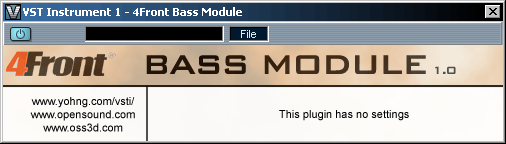
| 4FRONT BASS MODULE (VSTi) The bass module is a morph between sample playback and a synthesizer. Original string excitation is sampled, and then sound is modeled. Playing chords will add extra fat rumble, like when playing a real bass guitar. Bass guitar range was artifically extended up and down, so that higher notes and parts can be played as well. |
||
|
4FRONT RHODE MODULE (VSTi)
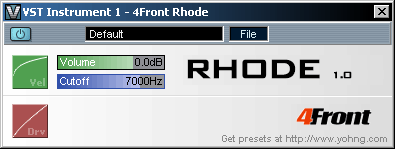
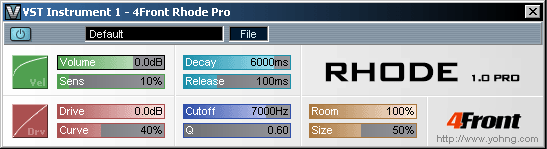
A vintage Rhodes/Wurly typed piano module with gentle overdrive. This module reproduces the classic sound similar to Rhodes/Wurlitzer pianos. Module is not sample based, and the sound is generated on-the-fly, therefore there are no sampling layer switches - vintage rhodes overdrive is smooth, clean and continuous. Difference between Basic (free) and Pro (commercial) modules To get a common idea of what exactly is different, check the screenshots below: Basic version:
As you can see, basic version is generally lacking envelope, sensitivity/drive and room controls, that Pro version has. If you like to get this kind of controlling over 4Front Rhode sound, you may want to get Pro version. MP3 Demos |
||
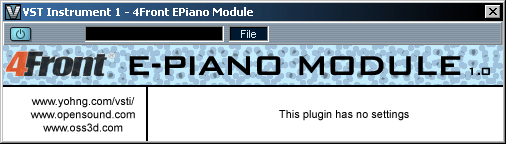
| 4FRONT E-PIANO MODULE (VSTi) E-Piano module with a rich, warm and silky sound. It is quite unique by its character. The module is made with a hybrid technology, which involves sample playback and synthesizing within one case. For its quality, module has reasonable small size. |
||
|
4Front XLimiter (VST/DX)
A gentle and soft brickwall limiter processor. Primary design goals: - Master track brickwall compression - Vocal track compression - Solo track compression A special multistage algorithm provides a very soft transition envelope, thus rapid level changes at extreme Threshold level will not pump or distort as much as with the other processors. The limiter employs best properties of a single band processor, whereas additional techniques are used to provide advantages of "continuous multiband" processing. Usage: With the default settings it will limit the signal at 0dB. This is useful to plug into the master effect bin of a multitrack software. You can lower Threshold value to bring up the volume of the track. If you are limiting a vocal track - you can also set appropriate ceiling value to control the output volume. If you have deessing or disturbing frequencies problem, try using this effect as a vocal or solo processor. In most cases you will not need an additional de-essing, as XLimiter will handle those transients properly. 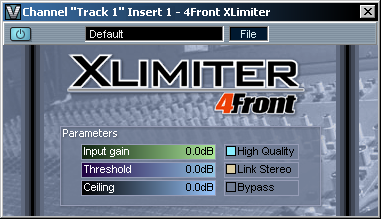 |
||
|
4FRONT AUXITER (VST/DX)
This is a high frequency refresher exciter-type plugin. It brings clarity to the high end by regenerating high frequency harmonics. Primary design goals: - Vocal enhancer - Per/track enhancer - Master track restoration/refreshment - Old tracks restoration Usage: First try to figure right Frequency slider value for your track, then control the Harmonic, Drive and Mix levels to get the best enhancement. 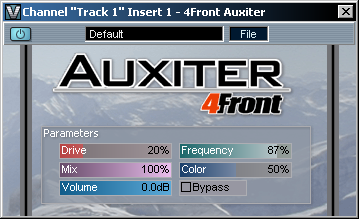 |
||
| 4FRONT SAND BRUSH (VST/DX) The plugin completely regenerates high frequencies, basing on the existing partials. The plugin can be used to apply on hihats and other percussive sounds with high frequency content, and also can be used on other tracks to add "sand". Depending on the settings, plugin can be also used to emulate the vintage vinyl sound. Primary design goals: - Sand for vocal and solo tracks - Bring life back to sampled strings - Track restoration (including MP3) - Vintage effect (to create vintage sound) The plugin contains multiple presets for various track types. 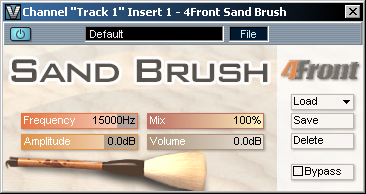 |
||
| 4FRONT CONTOUR MAX (VST/DX) The plugin is designed to change the basic frequency contour of a sound track, or the overall frequency balance of a master. Primary design goals: - Master processing - Per-track processing for balancing low and high end - Track restoration The plugin contains multiple presets for various track types. 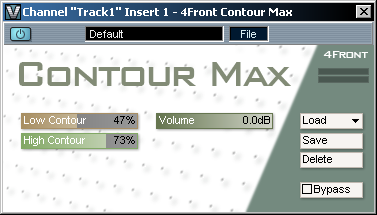 |