
Multi-currency*
You can watch and trade several currency pairs at the same time.
All charts are synchronized and updated tick-by-tick.
* Available only in MT5 version of the simulator


Forex Simulator works as a plugin to Metatrader. It combines great charting capabilities of MT4 and MT5 with quality tick data and economic calendar to create a powerful trading simulator.
Use charts, templates and drawing tools available in Metatrader.
Forex Simulator lets you move back in time and replay the market starting from any selected day.
You can watch charts, indicators and economic news as if it was happening live...
...but you can also:
Everything works just like in real life, but there is no risk at all!
Watch your profit/loss, equity, drawdown and lots of other numbers and statistics in real time.
You can also export trading results to Excel or create a HTML report.
You can analyze your trading results to find weak points of your strategy.
Trading historical data saves a lot of time compared to demo trading and other forms of paper trading.
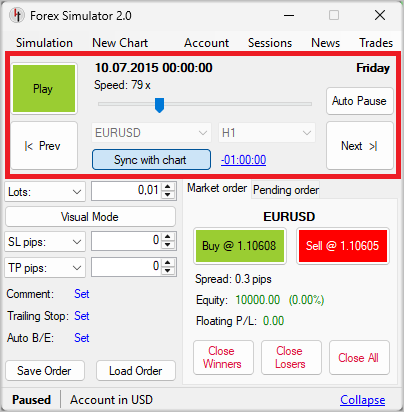
It also allows you to adjust the speed of simulation, so you can skip less important periods of time and focus on more important ones.
You can watch and trade several currency pairs at the same time.
All charts are synchronized and updated tick-by-tick.
* Available only in MT5 version of the simulator
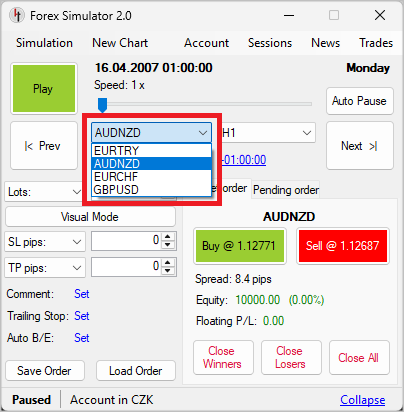
On Metatrader 5:
On Metatrader 4:
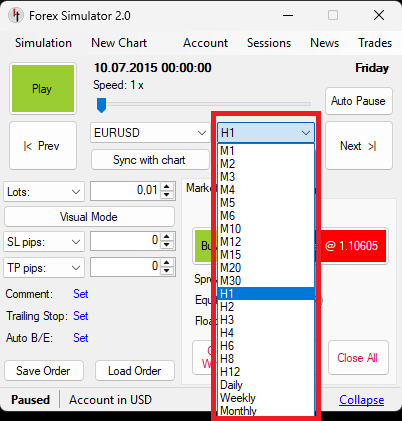
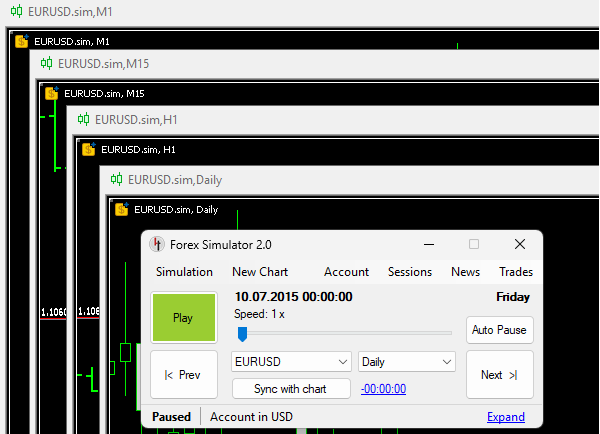
You can open several charts at once and follow price action on several timeframes.
All charts are synchronized and updated tick-by-tick.
You can also tell the program to pause the simulation automatically on certain events:
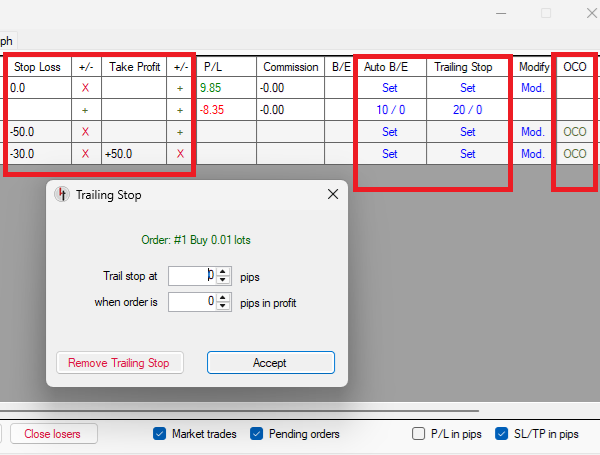
Following automatic rules can be applied to any trade:
Moreover, you can use order templates to work faster and avoid repeating the same steps. A template can be used to save your trade management rules and load them at any time.



(Thickness Class)
Internal chassis brackets, clips, and small stamped steel components hidden from direct weathering.
Understanding this code ensures that automotive, industrial, and construction hardware meets exact durability and engineering performance requirements. Breaking Down the Code: What Does "Fe/Zn 8/B" Mean?
Understanding the process helps you identify defects later.
For context, DIN 50961 includes several other passivation codes, each offering a different balance of corrosion protection and appearance. din 50961 fe zn 8b
Unprotected zinc reacts rapidly with oxygen and moisture, creating white zinc oxide or carbonate—commonly known as "white rust." To slow down this process, components undergo a chemical dip right after plating to form a , or passivation layer. DIN 50961 Electroplated ZN Coating | PDF - Scribd
By decoding the standard—Fe for steel, Zn for zinc, 8 for microns, and b for blue—you empower yourself to specify, inspect, and criticize surface coatings with authority. Whether you are restoring vintage hardware or designing the next generation of electric vehicle fasteners, understanding this code ensures your parts survive their intended service life without costly field failures.
(Post-Treatment / Chromate Type)
Because 8 microns is a relatively thin coating, this specification is not recommended for harsh marine environments, heavy industrial zones, or prolonged, unsheltered outdoor exposure. For those conditions, thicker coatings (such as 12 to 25 microns) or thick-film passivations are required. Typical Applications Understanding the process helps you identify defects later
DIN 50961 defines precise guidelines for electroplated coatings (galvanic layers) on various metals like iron, steel, copper, zinc, and nickel. The standard applies only in conjunction with (or the previously applicable DIN EN 12329), which sets the fundamental requirements for electroplated zinc coatings with supplementary treatments. In addition to DIN EN ISO 2081, DIN 50961 specifies minimum corrosion resistance according to the DIN 50018 KFW 2.0 S test, and recommended minimum coating thicknesses . For zinc coatings without any post-treatment, the standard defines corrosion resistance based on the DIN 50018 KFW 2.0 S test and the neutral salt spray test (NSS) according to ISO 9227:1990.
The combination of an 8-micron zinc layer and a blue passivation finish provides moderate corrosion protection. It is ideally suited for indoor environments or sheltered outdoor applications.
High-strength steels (tensile strength > 1000 MPa) require baking at 190–220°C for 4–24 hours to diffuse trapped hydrogen, preventing sudden failure under load.
Electrodeposited zinc coating, 8 µm minimum local thickness on all functional surfaces, followed by trivalent blue/clear chromate passivation. No white rust before 8 hours NSS per ISO 9227. Hydrogen embrittlement relief: Bake at 200°C for 8 hours within 4 hours of plating for steel >1000 MPa. DIN 50961 Electroplated ZN Coating | PDF -
Raw electroplated zinc tarnishes rapidly when exposed to atmospheric moisture, forming white zinc oxides (commonly known as "white rust"). To delay this process, the plated part is dipped into a chemical passivation solution. Passivation Type DIN 50961 Code Typical Appearance Corrosion Resistance Transparent to slight blue Low to Moderate Yellow Iridescent B Yellow, brassy, or rainbow High Olive Green Dark green / brown Black Shiny or matte black Moderate to High The Cr6+ vs. Cr3+ Transition
8 to 24 hours (corrosion of the zinc passivation layer itself).
The zinc layer, designated as "Zn," is applied using an electrolytic (electroplating) process. The component to be plated is suspended in a zinc salt solution, and an electric current is passed through it, causing zinc ions to deposit onto its surface. This process is precisely controlled to achieve the required 8 µm thickness. DIN 50961 defines a range of possible thicknesses, with Zn5, Zn8, Zn12, and Zn25 being the most common, representing coatings of 5, 8, 12, and 25 µm, respectively.