Beyond his academic posts, Professor Husain was a powerhouse of writing. His ability to simplify complex geographical concepts into clear, cogent language is a hallmark of his style, making his books accessible to all. The sheer scale of his literary contribution to geography is staggering:
: Land use patterns, major crops, and "Green Revolution" impacts.
Locate India's mineral belts (like the Chota Nagpur Plateau), analyze the spatial distribution of conventional and renewable energy resources, study cropping patterns, and understand the factors governing industrial localization (e.g., iron and steel, textiles).
Be prepared to draw structural cross-sections of the Himalayas or explain the geological differences between the Western and Eastern Ghats. 2. The Drainage System majid husain indian geography
The book maps directly to the UPSC General Studies Paper I syllabus. It transitions smoothly from physical landscapes to socio-economic realities, ensuring no topic is left unaddressed. 2. Analytical and Lucid Language
Which (e.g., Monsoons, Drainage, Agriculture) do you find hardest? What year are you targeting for your exam?
: For students with Geography as an optional subject, his books on Human Geography Models in Geography are considered indispensable. KPR IAS Academy of the latest edition or specific study tips for the Geography portion of the UPSC exam? Best Geography Book for UPSC Preparation 2025 Beyond his academic posts, Professor Husain was a
Husain's work on regional geography focused on the geographical characteristics of different regions in India. He studied the geographical features, economic activities, and population characteristics of various regions, including the Himalayan region, the Indo-Gangetic Plain, and the Deccan Plateau. His research on regional geography provided valuable insights into the diverse geographical and cultural characteristics of different regions in India.
#UPSCPrep #Geography #MajidHusain #BooksForUPSC
This public link is valid for 7 days and shares a thread, including any personal information you added. This link or copies made by others cannot be deleted. If you share with third parties, their policies apply. Can’t copy the link right now. Try again later. Locate India's mineral belts (like the Chota Nagpur
For decades, mastering the vast and intricate geography of India has been a formidable challenge for students and aspirants of competitive examinations. Among the sea of reference books available, one name consistently stands out for its authority, clarity, and comprehensive coverage: . His seminal work, Indian Geography (often published as Geography of India ), has become an indispensable cornerstone of preparation for the Union Public Service Commission (UPSC) Civil Services Examination (CSE) and numerous other state-level exams. This article delves into the legacy of the author, the unique features of the book, its alignment with exam syllabi, and why it continues to be the gold standard for geographical studies in India.
In conclusion, Majid Husain is a prominent Indian geographer who has made significant contributions to the field of Indian geography. His work has had a profound impact on our understanding of India's physical, human, and regional geography. As a scholar and teacher, he has inspired generations of geographers, and his legacy continues to shape the discipline of geography in India and beyond.
Majid Husain’s Geography of India provides a comprehensive analysis of the subcontinent through various lenses: Indian And World Geography By Majid Husain
The torch of this legacy is now being carried forward by new authors, ensuring the books remain relevant for a new generation of aspirants.
Geography is an inherently visual subject. Professor Husain’s book features excellent schematic diagrams of delta formations, mountain passes, monsoon winds, and industrial clusters. Practice drawing these diagrams freehand in under 60 seconds so you can easily replicate them in your Mains answer sheets. Step 4: Update with Current Affairs

The vision of Maps-For-Free is to offer free worldwide relief maps and other layers which can easily be integrated into existing map projects.
MFF-maps are released under Creative Commons CC0. You are free to adapt and use the relief maps and relief layer for commercial purposes without attributing the original author or source. Although not required, a link to maps-for-free.com is appreciated.
SRTM (Shuttle Radar Topography Mission) was developed to collect three-dimensional measurements of the Earth's surface to generate a near-global digital elevation model (DEM). The mission was a cooperative project between the National Aeronautics and Space Administration (NASA), the National Geospatial-Intelligence Agency (NGA) of the U.S. Department of Defense (DoD), and the German and Italian space agencies.
SRTM flew on board the Space Shuttle Endeavour in February 2000 and used an interferometric radar system to map the topography of Earth's surface. Endeavour was launched in an orbit with an inclination of 57 degrees which allowed to map all of the Earth's landmass that lies between 60 degrees North and 56 degrees South.
SRTM data was processed into geographic tiles, each of which represents one by one degree of latitude and longitude. A degree of latitude measures 111 kilometers North South, a degree of longitude measures 111 kilometers East West or less, decreasing away from the equator. Each tile of this dataset contains 1201x1201 samples which is equipollent to a 90 m grid resolution at equator. All tiles together represent an image sized 432000 x 139200 pixel.
For technical reasons data are available between 60 degrees North and 56 degrees South latitud only. The relative horizontal accuracy is about ± 15 m, the relative vertical accuracy about ± 6 m. The original data came with data voids indicating insufficient contrast in the radar data. These data voids tend to occur over water bodies (lakes, rivers, coasts, etc.), areas with snow cover and in mountainous regions.
The original SRTM data are available from USGS.
GTOPO30 is another free geographic dataset with a resolution of 43200 x 21600 pixel used to cover regions where SRTM data are not available. Streaky regions denote areas where data voids were extrapolated or where SRTM data were replaced by the lower resolution GTOPO30 data.
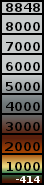
The relief maps are elevation maps, i.e. the coloring does not reflect the natural colors of scenic objects. Because one color is used for each ground level, some rivers and other objects may appear in unnatural colors. Lowland areas containing only few elevation information appear most likely single-colored.
In some cases the SRTM or GTOPO30 dataset failed to include small islands, and in other cases the islands are slightly mispositioned.
The GTOPO data are also available from USGS.
VMap0 provides worldwide coverage of geo-spatial data and is equivalent to a scale of 1:1000000. The data are structured following the Vector Product Format (VPF) and can be downloaded from GIS-Lab. Most of the MFF-layers are based on one of the thematic data vmap0 layer.
Hans Braxmeier, hans.braxmeier@outlook.com