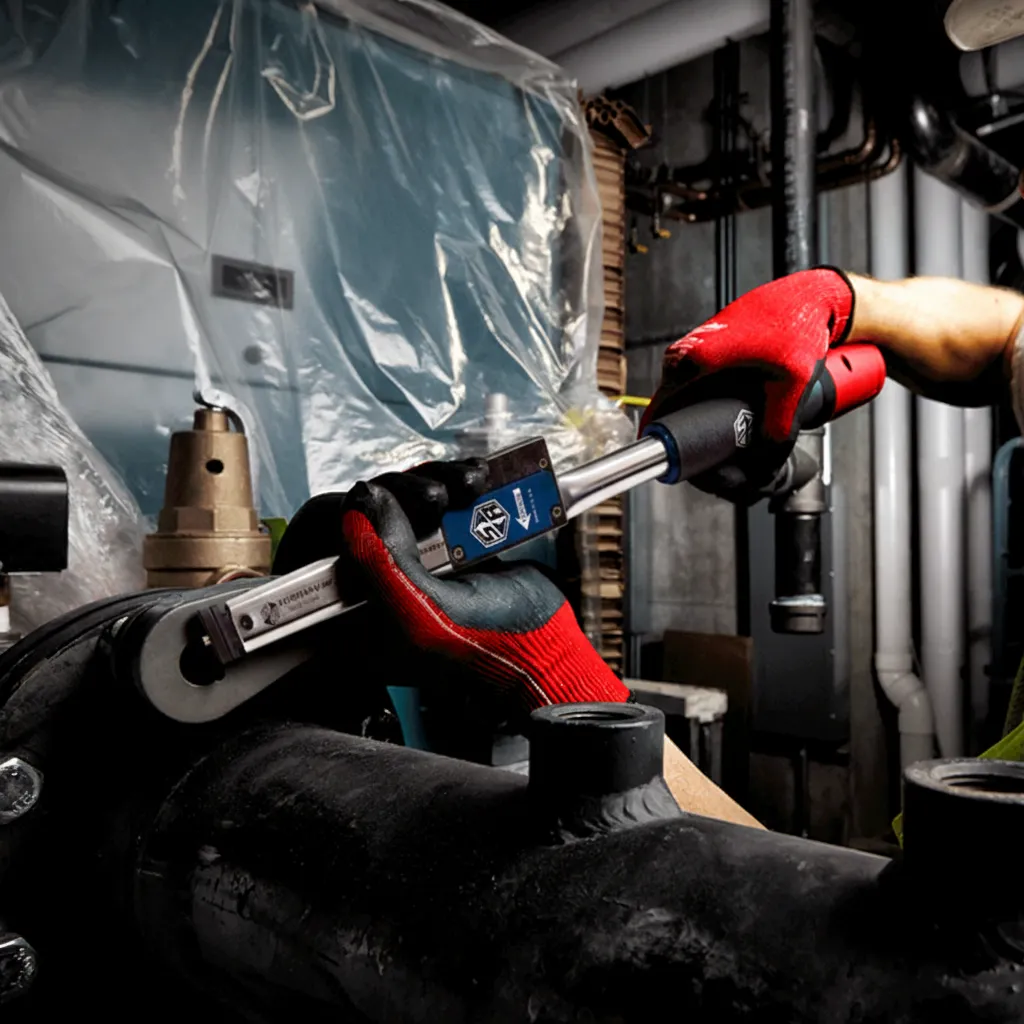
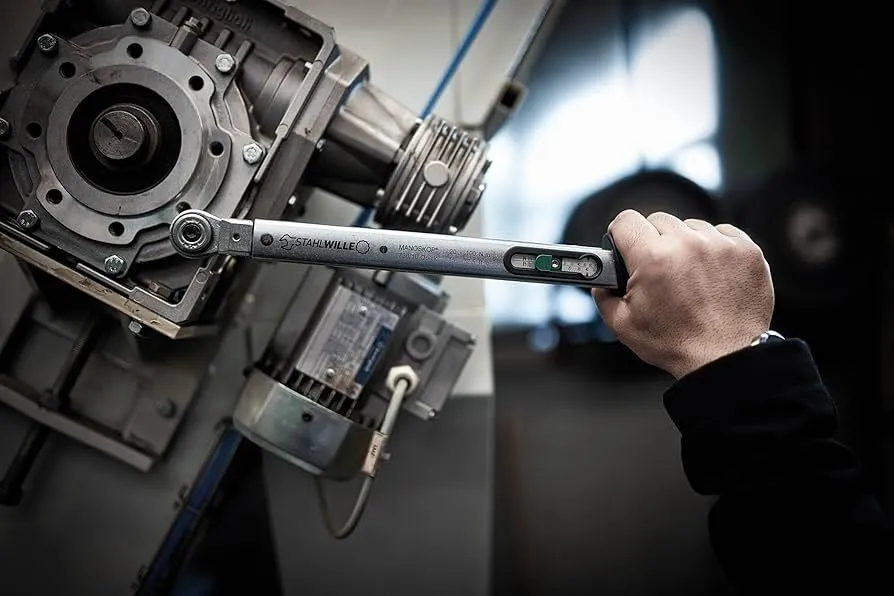
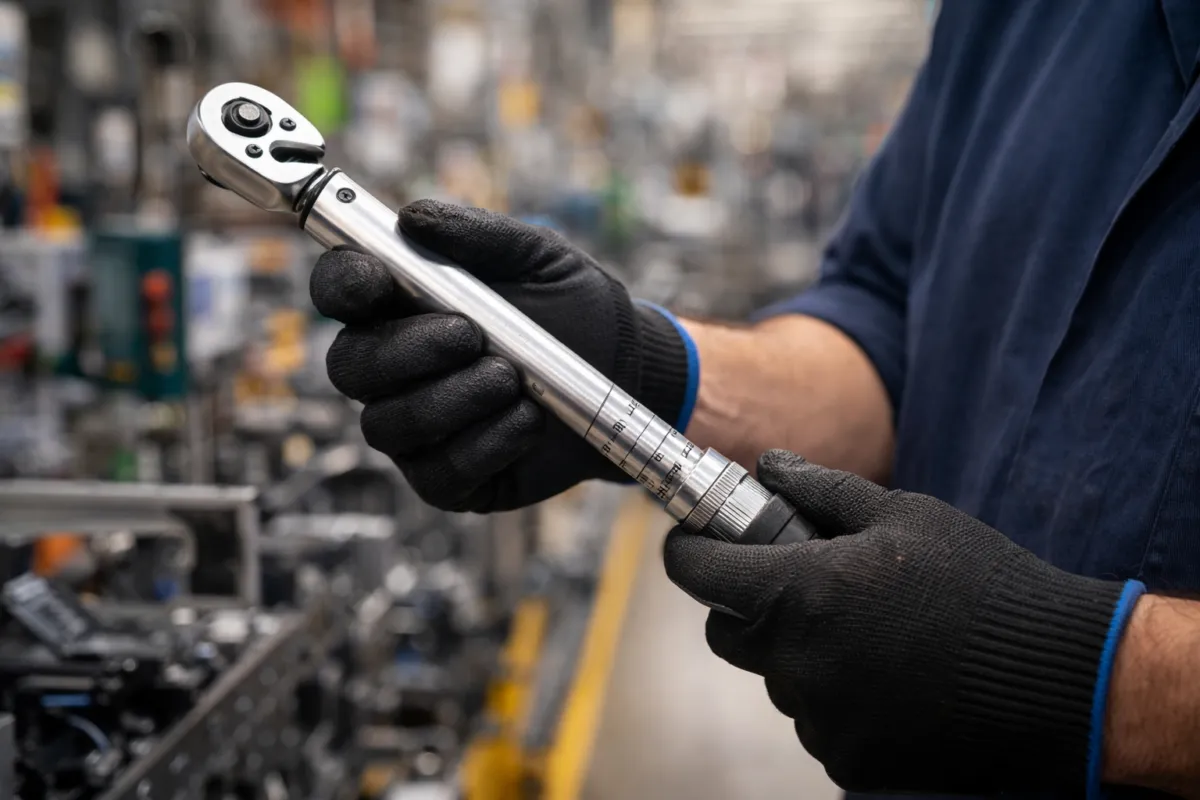
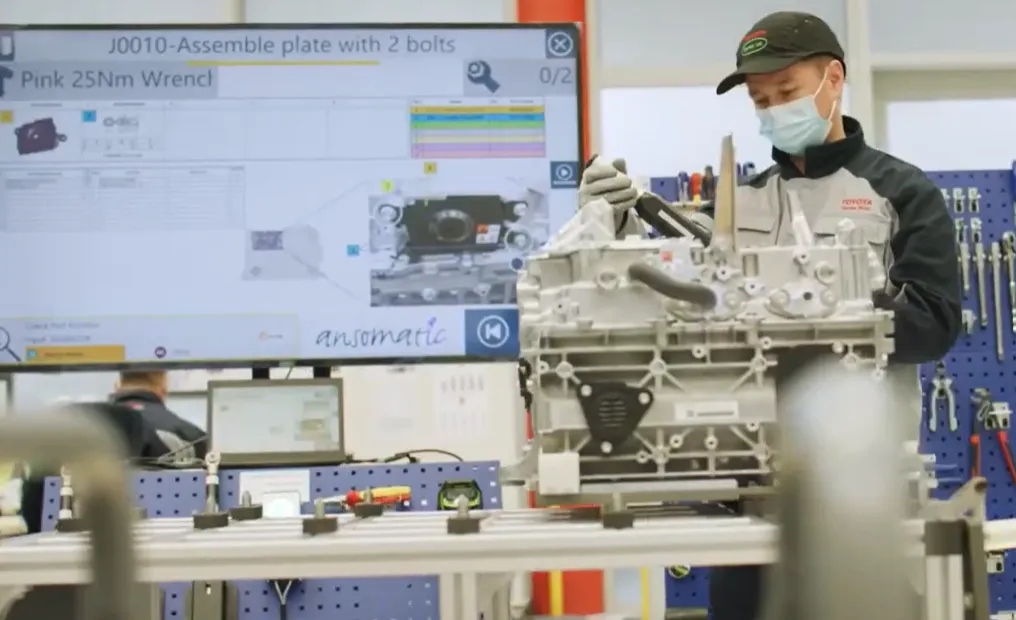
Modern manufacturing demands absolute fastening accuracy, full process traceability, and maximum operator safety. Our range of digital torque wrenches delivers precise, repeatable tightening for safety-critical industrial applications where traditional tools are no longer sufficient. Each digital torque wrench is equipped with advanced electronic measurement technology to verify every tightening operation in real time, ensuring that every joint meets the required specification while providing clear OK / NOK feedback to the operator.
In torque-controlled assembly environments there are two main categories of tightening tools: manual torque tools such as the digital torque wrench and motorized tools such as electric screwdrivers and nutrunners.
The fundamental difference is that a digital torque wrench relies on the operator’s manual force to tighten the joint while the tool precisely measures the applied torque, whereas an electric screwdriver uses its internal motor to generate digital torque automatically.
Because electric screwdrivers are designed for speed, they are much faster for running down fasteners in high-volume production. However, digital torque wrenches are significantly more accurate, making it the preferred solution when tightening quality, process reliability, and documentation are critical.
A digital torque wrench (also called an electronic torque wrench) is a hand-held tightening tool equipped with an internal electronic strain gauge. This sensor continuously measures torque and angle while the operator tightens the fastener.
Modern digital torque wrenches provide:
This makes the digital torque wrench ideal for applications where:
Electric torque wrenches offer significant advantages over manual, non-smart torque wrenches, making them the preferred choice for professional and industrial applications. A digital torque wrench provides higher accuracy and consistent torque measurement, thanks to its electronic sensors and clear digital display. Unlike a manual torque wrench, it reduces the risk of user error by giving real-time feedback and audible or visual alerts when the desired torque is reached.
Many electric drive torque wrenches also include data logging features, allowing users to record and track torque values for quality control and compliance. In addition, a digital torque wrench enables faster operation, easy unit conversion, and precise torque settings, improving efficiency and ensuring reliable results in critical fastening tasks.
A traditional click wrench uses a mechanical release mechanism that produces a loud click and a slight break in the handle when the preset torque is reached. This method is simple, but it can be difficult to hear in noisy factories and often causes wrist shock due to the mechanical release.
A vibrating electronic torque wrench replaces the mechanical click with electronic feedback. Inside the tool, an electronic strain gauge measures the applied torque continuously and, when the target torque is reached, the handle vibrates strongly while an LED ring changes color, typically green for accepted and red for rejected joints. Because there is no mechanical break, the operator simply feels the vibration and stops pulling, which greatly improves ergonomics, reduces wrist strain, and prevents over-tightening. This makes the vibrating digital torque wrench especially effective in noisy production environments where audible signals are unreliable and where consistent fastening quality is essential.
Choosing the right digital torque wrench depends on how the tool will be used and the level of control, accuracy, and torque monitoring required within your process. Whether you are selecting an digitaltorque wrench for quality control or an electric torque wrench for production, understanding your application is key to making the right decision.
The first step is to determine if the tool will be used in a production environment or for inspection. Production applications often require advanced functionality such as programmable tightening strategies, torque-and-angle control, and integration with factory systems. In these cases, an electric drive torque wrench combined with a controller enables centralized management, real-time torque monitoring, and full traceability across multiple tools.
Another important consideration is accuracy and data capture. Standard applications may only require basic OK/NOK feedback with repeatability around ±4%, while safety-critical environments demand higher precision (±1%) and complete data logging of torque and angle values. Selecting the correct digital torque range is also essential to ensure the tool operates within its optimal performance window for your specific application.
Operator feedback and usability should also be evaluated. Some users prefer a traditional click-based digital torque wrench, while others benefit from vibration or visual feedback, especially in noisy environments where clear operator guidance improves consistency.
Finally, consider power supply and connectivity options such as USB charging, rechargeable batteries, or charging cradles, as well as communication technologies like RF, Bluetooth, or Wi-Fi. These features are particularly important when integrating an electronic torque wrench into a broader manufacturing or quality system.
Ultimately, the choice is driven by application complexity: standalone tools are ideal for simpler tasks, while connected systems with advanced torque monitoring and control are essential for high-volume production environments where accuracy, traceability, and efficiency are critical.
Learn more about how to choose the right electric screwdriver for your application.
Production environments
Require advanced features such as:
👉 Best fit: Electric drive torque wrench + controller
Enables real-time monitoring, centralized control, and full traceability.
Inspection / quality control
👉 Best fit: Standalone digital torque wrench
Learn more about how to choose the right electric screwdriver for your application.
Al-Buni’s legacy is complex. He is revered by some as a saintly figure and an authority on Islamic esotericism but criticized by others for popularizing texts on magic squares ( awfaq ), letter symbolism (``ilm al-huruf`), and invocations that some consider shirk (idolatry). His works systematically categorize the numerical and mystical properties of the Quranic letters and Divine Names, claiming they can harness cosmic energies for healing, protection, or influence.
This public link is valid for 7 days and shares a thread, including any personal information you added. This link or copies made by others cannot be deleted. If you share with third parties, their policies apply. Can’t copy the link right now. Try again later.
For academic verification, the catalog record of provides the definitive bibliographic record of a physical print copy. The specific entry confirms the publication in Cairo (Maktabat al-Qahira), the authorship to "al-Imam Abi al-‘Abbas Ahmad ibn ‘Ali al-Buni al-mutawaffa sanah 622 H," and the structure of the four treatises. Cross-referencing your digital PDF with Stanford’s metadata is the gold standard for verification.
In the context of the search for a Manba' Uṣūl al-Ḥikmah PDF, the word "verified" holds profound weight. The controversy highlighted by Ustaz Faizar is essential to understand. Many circulating versions, especially popular online, are believed to be , having been intermixed with magical ( sihr ) elements and practices that contradict Islamic teachings. This aligns with the views of major Islamic councils, such as the Indonesian Ulema Council (MUI) , which has issued fatwas declaring the practice of consulting dukun (shamans) and engaging in sorcery ( sihr ) as haram (forbidden) and leading to syirik (polytheism).
Exploring the esoteric values and spiritual properties of letters and numbers. manba ushul al hikmah pdf verified
The text heavily emphasizes the utilization of the 99 Names of Allah. It outlines specific counts ( Zikr ) and conditions required to unlock the spiritual benefits of each Name.
Because this text deals with esoteric practices, talismanic magic, and spiritual philosophy, the search for a "verified PDF" often feels like a quest in itself. Here is a story built around that search. The Cipher of the Seven Suns Elias didn’t want power; he wanted a translation.
Manba Ushul al-Hikmah remains a fascinating window into the intellectual and spiritual history of the medieval Islamic world. Whether you are studying the text for its historical context, its unique blend of mathematics and mysticism, or its linguistic value, utilizing a is the only way to ensure your research is grounded in the author's actual work. Always cross-reference digital downloads with academic catalogs to guarantee textual integrity. Share public link
(The Source of the Origins of Wisdom) is a cornerstone of classical Islamic esoteric literature. Attributed to the renowned 13th-century mathematician, philosopher, and Sufi scholar Ahmad al-Buni (d. 622/1225), this work serves as an essential manual for practitioners of Ilmu Hikmah (the science of wisdom). The Core of Esoteric Knowledge Al-Buni’s legacy is complex
Over centuries of hand-copying, scribes occasionally made errors in the complex mathematical magic squares ( Awfaq ) or the spelling of specific formulas. A verified copy ensures you are reading an authenticated manuscript or a carefully edited print (such as the historic Maktabat al-Sha'b or Al-Maktabah al-Thaqafiyah editions).
Elias clicked. The file was massive. As it downloaded, his laptop fan began to whine, a high-pitched metallic scream that didn't stop even when the progress bar hit 100%.
Aras glanced at the clock on his taskbar. It was 6:45 PM. Outside the window, the sun had already dipped below the horizon of the Bosphorus, leaving the city in a dark, rainy twilight. The only light in the room came from the laptop screen, illuminating the ancient text.
Islamic tradition often emphasizes that these sciences should be approached with strict spiritual discipline. Historically, scholars recommended prerequisites such as maintaining ritual purity ( wudhu ), constant obedience to God, and following the Sunnah before engaging with the deeper secrets found in Al-Buni's works. This public link is valid for 7 days
When searching for a verified PDF, avoid anonymous file-sharing blogs or unverified forums, which often host malware or corrupted files. Instead, rely on reputable digital archives and academic repositories: Open-Access Academic Libraries
I can provide more targeted historical context or point you toward specific academic libraries that hold al-Buni's collection.
: Outlines the scope of mystical principles and the author's objectives.
| Digital Click Torque Wrenches | Digital Vibrating Torque Wrench | ||||||
| Type | Sturtevant Richmont | Sturtevant Richmont | BMS Torque Solutions | NovaTork | Stahlwille | NovaTork | Crane |
| Brand | |||||||
| Model | ![]() | ![]() | ![]() | ![]() | ![]() | ![]() | ![]() |
| Brand Name | SLTC 2.4 GHz Click Wrench | TAC 2 Click Wrench | Smart Click Wrench | Preset Torque Wrench | Manoskop 766 ADAPTIQ | QC Torque Wrench | WrenchStar Multi Torque Wrench |
| Covering Range | 0,6…813Nm | 0,6…204Nm | 20…160Nm | 4…300Nm | 1…1000Nm | 0,6…1000Nm | 1…1500Nm |
| Number of models | 9 | 5 | 2 | 6 | 10 | 8 | 11 |
| Number of presets | 1 | 1 | 1 | 1 | 1 | unlimited | unlimited |
| Repeteability | +/-4% | +/-4% | +/-4% | +/-4% | +/-4% | +/-1% | +/-1% |
| Monitoring | click OK/NOK | Torque & Angle data | Torque & Angle data | Torque & Angle data | Torque & Angle data | Torque & Angle data | Torque & Angle data |
| Charger | rechargeable batteries | Charger Craddle | rechargeable batteries or USB | rechargeable batteries or USB | rechargeable batteries or USB | rechargeable batteries or USB | Charger Craddle |
| Communication | 2.4GHz RF | 2.4GHz RF | BlueTooth | WiFi | RF or BlueTooth | WiFi | 2.4GHz RF |
| Controller | Global 400 | Global 400 | None | None | DAPTIQ | None | TCI-2 Lineside |
![]() | ![]() | N/A | N/A | N/A | N/A | ||
| Controller capacity | up to 16 wireless wrenches | up to 16 wireless wrenches | N/A | N/A | N/A | up to 5 wireless wrenches | |
| Application | Production torque wrench | Production torque wrench | Production torque wrench | Production torque wrench | Production torque wrench | Qualiti Control Torque Wrench | Production Torque Wrench |
While specifications such as torque range and brand are useful, the most important differences between digital and electronic torque wrenches come down to three practical factors: control, accuracy, and flexibility.
First, consider whether the tool operates with or without a controller. Controller-based systems enable centralized torque monitoring, process control, and full traceability across multiple tools, making them essential for production environments. Standalone tools, on the other hand, are better suited for simpler applications or quality inspections where system integration is not required.
Second, accuracy has a direct impact on application suitability. Tools with ±4% repeatability are typically sufficient for general assembly, while applications in automotive, aerospace, or other safety-critical industries often require ±1% accuracy to guarantee consistent tightening results.
Finally, the number of presets determines how efficiently operators can handle multiple tasks. Single-preset tools are ideal for repetitive operations, whereas tools with multiple or unlimited presets allow quick switching between different tightening programs, supporting more complex and variable production processes.